
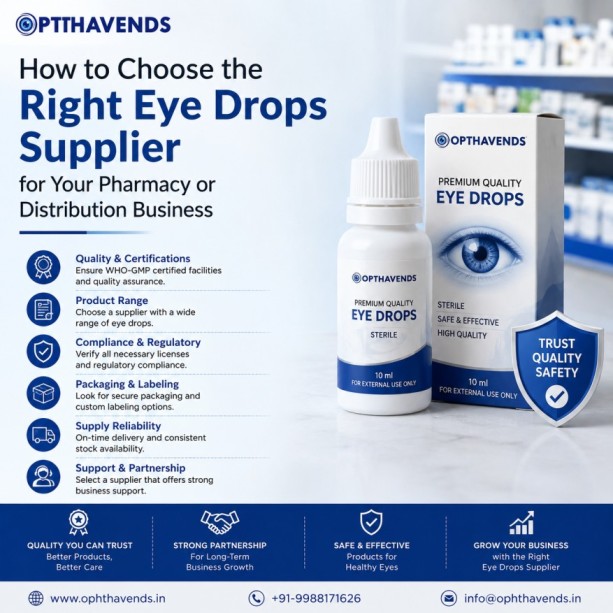
A right eye drops suppliers is a supplier which is licensed by CDSCO/FDA, manufactures under WHO-GMP or equivalent, has consistent batch to batch quality, has transparent pricing and MOQ terms and can ensure reliable, temperature controlled logistics. Failing to perform any of these checks puts your pharmacy or distribution business at risk for compliance penalties, stock disruptions and, in the worst cases, patient harm. This guide will show you just how to assess, interrogate, and verify a vendor before you sign a contract.
As a distributor or dispenser of ophthalmic pharmaceutical suppliers’ products, you are the last checkpoint between a manufacturing defect and the eye of the patient. That responsibility is why suppliers selection deserves the same rigor you’d apply to any other regulated pharmaceutical category — arguably more, considering how sensitive ocular tissue is to contamination.
Why Choosing the Right Eye Drops suppliers ?
Eye drops are sterile products for application in the eye. Unlike oral tablets, they are applied directly to a mucous membrane with a direct line to the bloodstream, and in rare but documented cases, the brain through the optic and olfactory pathways. This makes failures of sterility much more dangerous than in most other classes of drugs.
Risks of Partnering with an Unverified Suppliers
An unverified eye drops suppliers will look the same on the shelf as a compliant product, but they may cut corners in the manufacturing process. They are not theoretical consequences.
In February 2023, the US FDA linked a multistate outbreak of an extensively drug-resistant strain of Pseudomonas aeruginosa to an artificial tears product from a single Indian manufacturer. By May 2023, the CDC had identified 81 infections in 18 states tied to the contaminated eye drops, resulting in 14 patients losing their vision and four deaths. FDA’s inspection subsequently found the facility to be in violation of Current Good Manufacturing Practice regulations under 21 CFR Parts 210 and 211 (cite index=”6-1″). The same wave of enforcement action also extended to several other manufacturers cited for sterility failures that year (cite index=”5-1″).
The one case is now the benchmark regulators and pharmacy buyers look at when they discuss suppliers due diligence — and it shows why “the product looks fine” is never enough verification.
Unverified suppliers threaten your license, your inventory and your patients all at once. The common failure points are:
- Sudden stockouts when factory of unlicensed suppliers closes down mid-order
- Batch recalls that require you to pull stock already sold to customers
- Regulatory fines or suspension of licenses for stocking non-compliant products
- Reputational damage that is difficult to recover in a small or regional market
- Effect on Patient Safety & Business Reputation
Impact on Patient Safety and Business Reputation
A single suppliers failure doesn’t affect just one SKU for a pharmacy or distributor. One contamination event can lead to a complete audit of your purchasing records, damage relations with prescribing ophthalmologists, and erode the trust that was built over years with regular customers. In this category, patient safety and business continuity are the same conversation.
Key Factors to Evaluate Before Choosing a Supplier
Before you shortlist any ophthalmic medical supplies vendor, run their credentials through the following checklist:. Every item below corresponds to a document or verification step, not just a sales claim.
Licensing & Regulatory Compliance (CDSCO/FDA/GMP/WHO-GMP)
Verify the supplier has a valid manufacturing or wholesale licence from the relevant authority: CDSCO (Central Drugs Standard Control Organisation) for India or FDA registration for products destined for the US. Don’t take their scanned copy, ask for their license number and check it against the regulator’s public database.
Manufacturing Quality & Certifications
A trusted ophthalmology medical supplies manufacturer must be WHO-GMP, ISO 13485 (for devices like droppers) or other similar third-party certified, updated on a defined audit cycle. When was their last GMP renewal/inspection? Ask for the date on the certificate, not just the name of the certificate.
Product Range & Formulation Variety
A supplier with a wide and well-documented range – lubricants, antibiotics, antihistamines, anti-glaucoma formulations, preservative-free single-dose units – is a sign of manufacturing maturity. Narrow, single-SKU suppliers are more difficult to vet and more risky to rely on long-term.
Pricing, MOQ & Payment Terms
Compare cost per unit vs MOQ ( minimum order quantity ) and payment structure. One red flag to watch for is a supplier who offers unusually low pricing with no flexibility on MOQ or upfront full payment requirements.
Packaging & Shelf-Life Standards
Check tamper-evident seals, UV-resistant bottle material (many ophthalmic actives are light sensitive and degrade) and remaining shelf life at time of despatch – industry practice generally requires at least 70-75% of shelf life remaining on delivery.
Logistics, Delivery Timelines & Cold Chain (if applicable)
Some ophthalmic products need temperature controlled transportation . Ask for the supplier’s logistics partner, average transit time and how temperature excursions are documented and reported.
After-Sales Support & Return Policy
If a supplier is confident in the quality of their product, they will have a clear, written policy for return and replacement of damaged, expired-on-arrival or recalled stock. The absence of it in writing is a sign in itself.
| Criteria | What to Ask / Verify |
| Licensing | Current CDSCO/FDA license number, verified on the regulator’s public portal |
| Manufacturing quality | WHO-GMP/ISO certificate with issue and expiry dates |
| Product range | Full catalog with formulation types and active ingredients |
| Pricing & MOQ | Written quote with per-unit pricing tiers and MOQ thresholds |
| Packaging | Sample unit inspection for tamper-evidence and light protection |
| Logistics | Delivery SLA and cold-chain protocol (if applicable) |
| After-sales | Written return/replacement policy, signed and dated |
Questions to Ask Before Signing a Suppliers Contract
Before signing any agreement with an eye care product distributor or manufacturer, get direct answers to these:
- Please share your existing CDSCO / FDA license number for verification.
- When was your last WHO-GMP or ISO certification?
- Is it possible to send me the CoA for the particular batch that I am ordering?
- What is your MOQ, and can we get a trial order?
- What is the remaining shelf life on the batch at dispatch?
- What if batch fails quality inspection after delivery?
- Can you give me three verifiable client references in my area?
- What’s your average lead time from order confirmation to delivery?
Red Flags to Watch Out For
If you see any of the following, walk away – or at least stop and dig a little more:
- No license or GMP documentation provided, or documents not independently verifiable
- Batch quality differs between samples and delivered stock
- ever-changing or vague MOQ and pricing terms
- No written recall or return policy
- Unwillingness to provide client references or details of facilities
- Pressure to pay in full before any sample verification
How to Verify Suppliers Credentials
Verification isn’t a one-time event – it’s an ongoing part of responsibly managing an ophthalmic pharmaceutical suppliers relationship.
Checking GMP/ISO Certifications
Ask the suppliers directly for the certificate and check the name of the certifying body and the certificate number in the public registry of the issuing agency. Unconfirmed certificates are those that lack an issuing body which can be verified.
Requesting Sample Batches & Lab Reports
Always ask for a certificate of analysis (CoA) when you receive physical samples and, if possible, send samples to an independent lab for sterility and pH testing before placing a bulk order. This one step takes care of most of the quality problems before they reach your shelf.
Checking Client References
Speak to at least two or three current customers, ideally ones who are doing a similar volume of orders as you. The answer to the second question tells you more than the first. Ask specifically about the consistency of delivery and how the suppliers handled any past quality complaint.
Eye Drops Suppliers Checklist (Quick Reference)
| # | Checklist Item | Verified (Y/N) |
| 1 | Valid CDSCO/FDA license confirmed on public portal | |
| 2 | Current WHO-GMP/ISO certificate on file | |
| 3 | Certificate of Analysis received for sample batch | |
| 4 | Independent lab test completed (sterility/pH) | |
| 5 | MOQ and pricing terms documented in writing | |
| 6 | Shelf life at dispatch meets 70%+ threshold | |
| 7 | Packaging inspected for tamper-evidence | |
| 8 | Logistics SLA and cold-chain protocol confirmed | |
| 9 | Written return/replacement policy signed | |
| 10 | At least two client references contacted |
Choosing Between Manufacturer, Wholesaler, and Distributor
Depending on where you buy from, your pricing, control and risk exposure varies. That’s a different relationship than buying through an intermediary when you buy direct from an eye dropper manufacturer.
| Type | Pros | Cons | Typical MOQ | Pricing |
| Manufacturer | Lowest per-unit cost, direct quality control, custom formulation options | Higher MOQ, longer lead times, requires more due diligence | High | Lowest |
| Wholesaler | Lower MOQ, faster turnaround, aggregated stock from multiple brands | Less visibility into original manufacturing conditions | Medium | Mid-range |
| Distributor | Regional support, established compliance relationships, smaller order flexibility | Higher per-unit cost, less pricing negotiation power | Low | Highest |
A good rule of thumb: the closer you buy to source, the cheaper your cost but the greater your due diligence burden, and the further downstream, the more that burden shifts (for a price) to the intermediary.
Final Thoughts: Building a Long-Term Suppliers Relationship
Suppliers selection is not a one-off transaction. It is the beginning of a relationship you’ll be relying on for years of reliable, compliant stock. The pharmacies and distributors that avoid recalls and stockouts are almost without exception the ones who view verification as a habit, not a box checked at onboarding. Check your supplier’s certifications each year, maintain a record of batch quality, and don’t allow a good price to trump a gap in documentation. Working with a knowledgeable ophthalmic manufacturer such as Ophtha Vends can also help to simplify compliance by providing proper documentation, consistent product quality and reliable supply support.
Read our guide on evaluating ophthalmic pharmaceutical suppliers for bulk purchasing and understanding WHO-GMP certification criteria for pharmacy inventory for more insight into related sourcing decisions.
Frequently Asked Questions
1. What certifications should an eye drops suppliers have?
At least valid manufacturing license from CDSCO or FDA and WHO-GMP or any equivalent quality certification. If the suppliers also manufactures droppers or applicator devices, ISO 13485 certification is an added plus. Be sure to verify the certificate numbers with the issuing authority’s public database before ordering.
2. How do I verify if an eye drops manufacturer is GMP-certified?
Get the certificate directly and then check the certifying body and certificate number on the certifying body’s official registry or portal. Request the last audit date – a certificate from several years ago with no indication of renewal is a weaker signal than one dated within the last 12-18 months.
3. What is the minimum order quantity (MOQ) for bulk eye drops?
MOQs can vary greatly depending on the supplier type: manufacturers usually demand the highest volumes while wholesalers and distributors usually offer more flexible, lower thresholds. When you negotiate price, always get the minimum order quantity in writing first. Verbal quotes are often changed when you place an order.
4. How do I know if eye drops are safe for pharmacy resale?
Ensure that the batch is accompanied by a valid Certificate of Analysis, has sufficient remaining shelf life (preferably 70%+ at dispatch) and undamaged tamper-evident packaging. If you can, send a sample to an independent lab for testing for sterility before you place a full order.
5. What documents should a supplier provide before I place an order?
You can expect to see a current manufacturing / wholesale license, GMP or ISO certificate, Certificate of Analysis for that batch, and a written return / replacement policy. Any supplier who is unwilling to provide these up front before payment should be a red flag.
6. How often do eye drops suppliers get audited?
Regulatory audits of WHO-GMP or CDSCO-licensed facilities are typically conducted on a periodic renewal cycle, generally every 1 to 3 years, but this varies depending on the jurisdiction and facility risk classification. Don’t guess a timeframe, ask your supplier when the last audit was done.
7. Can I request free samples before bulk ordering eye drops?
Yes – most established ophthalmic medical supplies suppliers will provide samples together with a Certificate of Analysis, especially for first time buyers placing a meaningful trial order. Reluctance to provide samples at all is worth questioning.
8. What’s the difference between a wholesaler and a distributor for eye drops?
Wholesalers typically buy in bulk from a variety of manufacturers , and sell in bulk at a reduced price per item . Distributors typically have regional rights and can offer local compliance, logistics and smaller order fulfillment, but often at a higher cost per item.